Percentage to CGPA and CGPA to Percentage: Formula, Table and Examples
Convert percentage to CGPA and CGPA to percentage with the right formula. UGC 9.5 rule, flat 10 scale, offsets, full conversion tables, examples and FAQs.
 Written by Hamza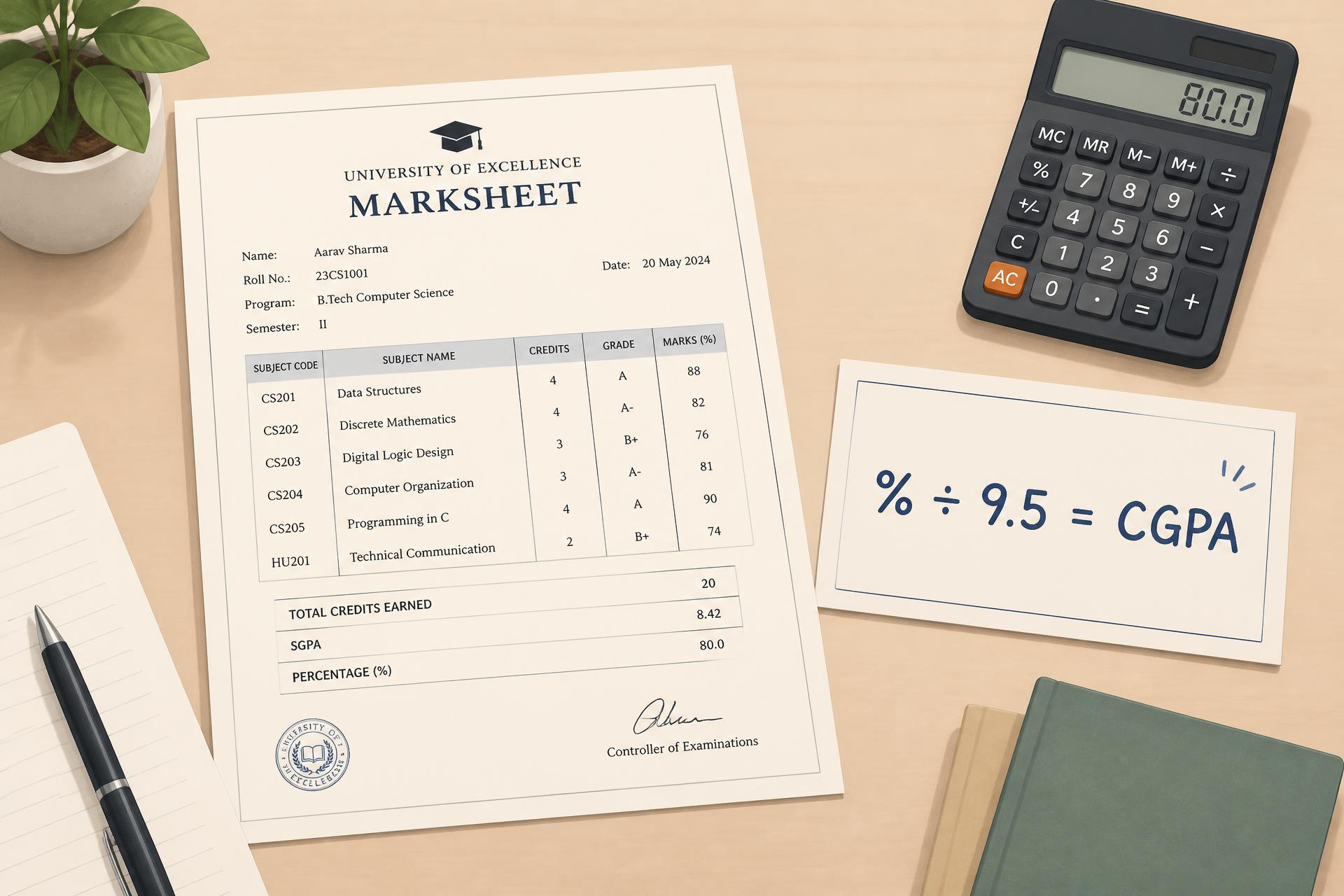
The quick answer
To calculate CGPA from percentage, divide your percentage by your institution's official conversion factor. For CBSE and most universities that follow the University Grants Commission (UGC) standard, that factor is 9.5, so the formula is CGPA = Percentage ÷ 9.5. A student with 76% gets 76 ÷ 9.5 = 8.0 CGPA.
But here is the part almost every other guide skips: 9.5 is not a national rule. Anna University, GGSIPU and several other institutions divide by 10 instead. Some engineering universities add an offset. Use the wrong one and your CGPA can be wrong by up to 1.5 grade points, enough to push you below a placement cutoff you actually cleared.
This guide gives you the formula, the exceptions, worked examples, a full conversion table, and a simple method to find your university's real formula in about five minutes.
Try it first: Use the free Percentage to CGPA Calculator at StudyZoneHub. Pick your university, enter your percentage, get your CGPA instantly, no sign-up, no ads.
What is CGPA?
CGPA stands for Cumulative Grade Point Average. It is a single number, usually between 0 and 10, that summarises your performance across every semester of your course. Instead of showing your marks out of 100, your college converts each subject's marks into a grade point, weights it by the subject's credits, and averages everything together.
Think of it like this. Percentage tells you how many marks you scored. CGPA tells you what level you performed at, on a fixed scale.
India moved to this system for a reason. In 2015, the University Grants Commission asked colleges and universities to adopt the Choice Based Credit System (CBCS) and a 10-point grading scale. Before that, most Indian universities used a high-stakes, marks-out-of-100 model that made it very hard to compare a student from one university with a student from another, or to transfer between institutions at all.
The UGC's recommended 10-point scale looks like this:
| Letter grade | Meaning | Grade point |
|---|---|---|
| O | Outstanding | 10 |
| A+ | Excellent | 9 |
| A | Very Good | 8 |
| B+ | Good | 7 |
| B | Above Average | 6 |
| C | Average | 5 |
| P | Pass | 4 |
| F | Fail | 0 |
| Ab | Absent | 0 |
Source: UGC, "Minimum Course Curriculum for Undergraduate Courses Under Choice Based Credit System," 2015.
So a CGPA of 8.0 does not mean you scored 8 marks out of 10. It means your average performance across all your subjects sat at the "A / Very Good" level.
CGPA vs SGPA vs GPA vs percentage
Students mix these four terms up constantly, and mixing them up is the fastest way to fill a form wrong. Here is the clean version:
| Term | Full form | What it measures | Typical scale |
|---|---|---|---|
| Percentage | , | Marks scored out of total marks | 0-100 |
| GPA | Grade Point Average | Average grade points, often for one term | 0-4 (US) or 0-10 (India) |
| SGPA | Semester Grade Point Average | Your performance in one semester | 0-10 |
| CGPA | Cumulative Grade Point Average | Your performance across all semesters | 0-10 |
The relationship in one line: subject grades → SGPA (one semester) → CGPA (whole degree) → percentage (when a form asks for it).
Two quick clarifications that save a lot of confusion:
- SGPA is not CGPA. If you have finished four semesters, you have four SGPAs and one CGPA. Do not write an SGPA where a form asks for CGPA.
- "GPA" means different things in different countries. In India it usually means a 10-point score. In the United States it almost always means a 4.0 scale. If a foreign university asks for your GPA, they mean the 4.0 version, see the study abroad section below.
If you are combining semester scores rather than converting a percentage, the GPA Calculator at StudyZoneHub handles that calculation directly.
Why students need to convert percentage into CGPA
Most students search for this because a form asked for a number their marksheet does not show. Your marksheet gives you one format. The form in front of you wants the other. Here are the seven situations where this happens most often:
- Your board gave percentage, your college form wants CGPA. Many state boards and older transcripts print only percentage marks. University admission portals increasingly ask for a grade point value.
- Study abroad applications. Foreign universities and credential evaluators need a grade point, not raw Indian marks, so they can compare you fairly against applicants from other countries.
- Campus placement portals. Company eligibility filters are usually written as CGPA cutoffs, "6.5 CGPA and above," "no backlogs", even when your college reports percentages.
- Scholarship applications. Many scholarship forms have a single grade field and no option to switch formats.
- Postgraduate admissions. M.Tech, MBA and MSc forms often ask for CGPA in the qualifying degree.
- Government job and PSU forms. Eligibility is checked against a stated threshold, and the form dictates the format.
- Comparing yourself to classmates from other universities. A friend says "I have 8.2." You have 78%. Are you ahead or behind? You cannot tell without converting.
The scale of this problem is enormous. According to the All India Survey on Higher Education (AISHE) 2023-24, released by India's Ministry of Education, total enrolment in Indian higher education reached a record 4.50 crore (45 million) students, with the Gross Enrolment Ratio hitting 30. Enrolment has grown 31.5% since 2014-15. Every one of those students will, at some point, be asked to report their result in a format their institution did not give them.
How to calculate CGPA from percentage in 5 steps
The core method: find your institution's official conversion factor, then reverse the formula it uses to turn CGPA into percentage. That is the whole idea. Your college has a rule for going one way. Converting percentage into CGPA just means running that rule backwards.
Here is the step-by-step process.
Step 1: Find your exact percentage
Use the percentage printed on your marksheet or transcript. If it is not printed, calculate it yourself:
Percentage = (Total marks obtained ÷ Total maximum marks) × 100
If you would rather not do this by hand, the Percentage Calculator at StudyZoneHub converts raw marks into a percentage in one step.
Example: A student scores 1,842 marks out of a maximum of 2,400. 1,842 ÷ 2,400 = 0.7675 0.7675 × 100 = 76.75%
Do not round this number yet. Rounding early is one of the most common errors in this whole process, and we will come back to why.
Step 2: Identify your institution's conversion factor
This is the step that decides whether your answer is right or wrong. There are four common patterns in India:
| Pattern | Forward formula (CGPA → %) | Reverse formula (% → CGPA) |
|---|---|---|
| UGC / CBSE standard | Percentage = CGPA × 9.5 | CGPA = Percentage ÷ 9.5 |
| Flat scale | Percentage = CGPA × 10 | CGPA = Percentage ÷ 10 |
| 0.75 offset | Percentage = (CGPA − 0.75) × 10 | CGPA = (Percentage ÷ 10) + 0.75 |
| 0.5 offset | Percentage = (CGPA − 0.5) × 10 | CGPA = (Percentage ÷ 10) + 0.5 |
If you genuinely do not know which one applies to you, use the UGC standard (÷ 9.5) as your working estimate, and read the five-minute method further down to confirm it before you submit anything official.
Step 3: Apply the reverse formula
Take your percentage and run it through the reverse formula for your institution.
Example using the UGC standard: CGPA = 76.75 ÷ 9.5 CGPA = 8.08
The same 76.75% under the other three patterns:
- Flat scale: 76.75 ÷ 10 = 7.68
- 0.75 offset: (76.75 ÷ 10) + 0.75 = 8.43
- 0.5 offset: (76.75 ÷ 10) + 0.5 = 8.18
Four legitimate formulas, four different answers, one student. That spread is the whole reason this article exists.
Step 4: Round correctly, and only at the end
Round your final CGPA to two decimal places, which is what most Indian universities print on transcripts. Some print one decimal place. Match whatever your institution uses.
The rule that matters: round once, at the end. If you round 76.75% to 77% first and then divide by 9.5, you get 8.11 instead of 8.08. That looks like a tiny difference, but on a form with a hard cutoff, small differences decide outcomes.
Step 5: Sanity-check by converting back
This takes ten seconds and catches almost every arithmetic mistake. Take the CGPA you just calculated and run it forward through your institution's formula. You should land back on your original percentage.
Check: 8.08 × 9.5 = 76.76%. Original was 76.75%. Close enough, the tiny gap is just rounding. ✓
If your check lands somewhere far from where you started, you have either used mismatched formulas or made an arithmetic slip.
Where the number 9.5 actually comes from
The 9.5 multiplier comes from CBSE, and it is based on the midpoint of the top grade band, not on a mathematical law. Understanding this makes the rest of the article much easier to follow.
Under the CBSE grading system, the top grade (A1) covered marks from 91 to 100. The average mark of students landing in that band worked out to roughly 95. That band carried a grade point of 10.
So: 95 ÷ 10 = 9.5.
That is it. One grade point is treated as being worth about 9.5 percentage points, because that is what the real data showed at the top of the scale. CBSE published the rule in its results documentation as: "Overall indicative percentage of marks = 9.5 × CGPA."
Two things follow from this, and both matter:
First, the word "indicative" is doing real work. CBSE never claimed the converted number equals your true marks. Grade points group marks into bands. A student with 91% and a student with 99% both sit in the same band and both get a grade point of 10. Converting back can only ever give you an estimate of where you sat inside that band.
Second, 9.5 was calibrated for the top band, not the whole scale. It is a single multiplier applied across a curve that is not perfectly linear. It is a reasonable approximation, deliberately kept conservative, but an approximation nonetheless.
This is also why a perfect CGPA of 10 converts to 95%, not 100%. Students often find that confusing. It is not a bug. It reflects the fact that a grade point of 10 represents a band of high marks whose average is around 95.
The problem nobody tells you: there is no single Indian formula
The UGC standardised the 10-point grading scale in 2015, but it never issued a single binding national rule for converting between grade points and percentage marks. Individual universities filled that gap themselves, and they did not all fill it the same way.
This is not an internet rumour. It is documented in a February 2025 white paper on Indian grading practices published by AACRAO (the American Association of Collegiate Registrars and Admissions Officers), authored by Colleen P. Baillie, EdD, Director of Student Services and Enrollment Management at Temple University's Graduate School, and Deb Mamuti, International Scholar Advisor at The University of Alabama.
Their finding, in plain terms: the UGC mandated the 10-point scale but did not explain how institutions should map their existing marks-based grades onto it. Reviewing real transcripts from Indian institutions, the authors found wide variation in how the scale was implemented, noting that many universities "lack the uniformity the UGC emphasizes."
The paper documents concrete examples. At IIT Madras, the top grade is printed as S for "Superior" rather than the UGC's O for "Outstanding", and an American faculty member who has never seen an Indian transcript could easily read that "S" as "Satisfactory." The same paper found institutions where a grade point of 8 is labelled B, while the UGC's own scale calls 8 an A.
The authors' practical recommendation to credential evaluators is worth borrowing for yourself: trust the number, not the letter. The grade point is the reliable signal. Letter labels vary by institution.
Why this matters more now than it used to
Indian students are the largest international student group in the United States. The AACRAO paper cites reporting by Karin Fischer and Dan Bauman in The Chronicle of Higher Education showing that as of Fall 2023, roughly 320,000 people from India held active US student visas, compared with about 254,000 from China, and that over 75% of Indian students in the US are entering graduate programmes.
That means hundreds of thousands of Indian transcripts are being read every year by people who did not grow up with this system. Reporting the wrong converted number is not a small clerical matter.
Original data: how far apart the formulas really are
Most articles mention that formulas vary and move on. We wanted to know by how much. So we ran the numbers.
StudyZoneHub Original Analysis (August 2026). We took five documented Indian conversion formulas, reversed each one, and applied all five to the same percentage values from 50% to 95%. Then we measured the gap between the highest and lowest CGPA each percentage produced.
Finding 1: The average gap is a full grade point
| Percentage | UGC ÷9.5 | Flat ÷10 | +0.75 offset | +0.5 offset | Mumbai (engg) | Gap |
|---|---|---|---|---|---|---|
| 50% | 5.26 | 5.00 | 5.75 | 5.50 | 5.38 | 0.75 |
| 55% | 5.79 | 5.50 | 6.25 | 6.00 | 6.07 | 0.75 |
| 60% | 6.32 | 6.00 | 6.75 | 6.50 | 6.76 | 0.76 |
| 65% | 6.84 | 6.50 | 7.25 | 7.00 | 7.45 | 0.95 |
| 70% | 7.37 | 7.00 | 7.75 | 7.50 | 8.14 | 1.14 |
| 75% | 7.89 | 7.50 | 8.25 | 8.00 | 8.83 | 1.33 |
| 80% | 8.42 | 8.00 | 8.75 | 8.50 | 9.52 | 1.52 |
| 85% | 8.95 | 8.50 | 9.25 | 9.00 | 10.00 | 1.50 |
| 90% | 9.47 | 9.00 | 9.75 | 9.50 | 10.00 | 1.00 |
| 95% | 10.00 | 9.50 | 10.00 | 10.00 | 10.00 | 0.50 |
Average gap across the 50-95% range: 1.02 grade points. The widest gap sits at 80%, where the same percentage can be reported as anything from 8.00 to 9.52 CGPA, a spread of 1.52 points.
Notice where the damage is worst. The gap is largest between 70% and 85%, exactly the range where most First Class and Distinction students sit, and exactly the range where placement cutoffs are set.
Finding 2: Half of all percentages sit in an "eligibility grey zone"
We then tested the four most common formulas against five typical CGPA cutoffs (6.0, 6.5, 7.0, 7.5 and 8.0) and asked a simple question: for which percentages do the formulas disagree about whether a student clears the bar?
| Cutoff | Percentages where formulas disagree | Width of grey zone |
|---|---|---|
| CGPA 6.0 | 52.5% - 59.9% | 7.4 points |
| CGPA 6.5 | 57.5% - 64.9% | 7.4 points |
| CGPA 7.0 | 62.5% - 69.9% | 7.4 points |
| CGPA 7.5 | 67.5% - 74.9% | 7.4 points |
| CGPA 8.0 | 72.5% - 79.9% | 7.4 points |
Result: of every percentage value between 40.0% and 95.0%, exactly 50% fall inside at least one grey zone where the choice of formula alone decides whether the student appears eligible.
Here is what that looks like for one student. Take 72.5% and a company cutoff of 8.0 CGPA:
| Formula | CGPA | Clears an 8.0 cutoff? |
|---|---|---|
| UGC ÷ 9.5 | 7.63 | ✗ No |
| Flat ÷ 10 | 7.25 | ✗ No |
| +0.75 offset | 8.00 | ✓ Yes |
| +0.5 offset | 7.75 | ✗ No |
Same student. Same marks. Same day. One formula gets them into the interview room and three keep them out.
Methodology: reverse formulas applied to percentage values in 0.1-point steps from 40.0% to 95.0%; CGPA values capped at 10.0; forward formulas sourced from institutional circulars and regulations listed in the Sources section. You are welcome to reproduce or cite this analysis with attribution to StudyZoneHub.
The takeaway is not "the system is broken." It is much more practical than that: the formula you use matters more than the arithmetic you do. Get the formula right and the maths is trivial. Get the formula wrong and perfect arithmetic still gives you a wrong answer.
The 5 conversion formulas used in India
Here is each formula, who uses it, and how to run it in reverse.
1. The UGC / CBSE standard: divide by 9.5
Reverse formula: CGPA = Percentage ÷ 9.5
This is the most widely used conversion in India and the safest default when you have no other information. It applies to CBSE Class 10 results from the CCE era and is followed by a large number of universities. Delhi University is widely reported to have adopted it through a 2018 examination circular, worth verifying directly if you are a DU student, since we could not confirm it against a primary DU document.
Worked example: 76% ÷ 9.5 = 8.00 CGPA Worked example: 82.65% ÷ 9.5 = 8.70 CGPA
Use it when: your marksheet is from CBSE, your university follows the general UGC pattern, or you have no official guidance and need a defensible estimate.
2. The flat scale: divide by 10
Reverse formula: CGPA = Percentage ÷ 10
Several major institutions treat one grade point as exactly ten percentage points. This is the cleanest conversion to do in your head, just move the decimal point.
Two documented examples:
- Anna University states the conversion as Percentage of Marks = CGPA × 10 in a letter issued by its Office of the Additional Controller of Examinations, covering Regulations R-2015, R-2018 and R-2019 across UG and PG programmes.
- Guru Gobind Singh Indraprastha University (GGSIPU) states in Ordinance 11 (Semester System) that "The CGPA x 10 shall be deemed equivalent to percentage of marks."
Most IITs also treat the 10-point CGPA as directly equivalent to percentage.
Worked example: 80% ÷ 10 = 8.00 CGPA Worked example: 73.4% ÷ 10 = 7.34 CGPA
Use it when: your institution's regulations state a direct equivalence. Be careful here, a lot of aggregator websites incorrectly attach offset formulas to institutions whose own published ordinances say flat ×10.
3. The 0.75 offset
Reverse formula: CGPA = (Percentage ÷ 10) + 0.75
This pattern comes from the forward formula Percentage = (CGPA − 0.75) × 10. It is associated with VTU-affiliated engineering colleges in Karnataka and JNTU-affiliated institutions, and it is frequently cited as an AICTE-style convention for technical programmes. Sources disagree on which institutions currently use it, which is exactly why you should verify rather than assume.
Worked example: (72 ÷ 10) + 0.75 = 7.2 + 0.75 = 7.95 CGPA Worked example: (85 ÷ 10) + 0.75 = 8.5 + 0.75 = 9.25 CGPA
Use it when: your grade sheet or your university's regulations explicitly show the 0.75 deduction.
4. The 0.5 offset
Reverse formula: CGPA = (Percentage ÷ 10) + 0.5
From the forward formula Percentage = (CGPA − 0.5) × 10. This appears in Pondicherry/CENTAC contexts and in some Anna University regulation documents for later regulations. It sits neatly between the flat scale and the 0.75 offset.
Worked example: (81.1 ÷ 10) + 0.5 = 8.11 + 0.5 = 8.61 CGPA
Use it when: your specific regulation year documents a 0.5 deduction. Regulation year matters, the same university can use different rules for different batches.
5. Linear formulas with an intercept
Reverse formula (Mumbai University, engineering): CGPA = (Percentage − 11) ÷ 7.25
A few universities use a proper linear equation rather than a simple multiplier. Mumbai University's engineering conversion is commonly cited as Percentage = 7.25 × CGPA + 11. Calicut University has used band-based formulas where the rule changes depending on which range your result falls into.
Worked example: (75 − 11) ÷ 7.25 = 64 ÷ 7.25 = 8.83 CGPA
Use it when: your university publishes an explicit linear equation. These conversions can produce results above 10 at high percentages, which tells you the formula was designed for the forward direction, not the reverse. If your reverse calculation exceeds 10, cap it and treat the result as approximate.
University-wise formula table
Important: treat this table as a starting point, not as authority. Formulas change between regulation years, autonomous colleges affiliated to a university often set their own rules, and several widely-copied websites publish formulas that contradict the universities' own circulars. Your marksheet, your university's examination circular, and your controller of examinations always outrank any table on the internet, including this one.
| Institution / board | Commonly cited forward formula | Reverse (% → CGPA) | Confidence |
|---|---|---|---|
| CBSE (Class 10, CCE era) | CGPA × 9.5 | ÷ 9.5 | High, published by CBSE |
| Delhi University | CGPA × 9.5 | ÷ 9.5 | Medium, cited to a 2018 examination circular; verify |
| Anna University (R-2015/18/19) | CGPA × 10 | ÷ 10 | High, ACOE conversion letter |
| GGSIPU | CGPA × 10 | ÷ 10 | High, Ordinance 11 |
| Most IITs | CGPA × 10 | ÷ 10 | Medium-High |
| KTU (post-2023 rule) | CGPA × 10 | ÷ 10 | Medium |
| VTU | (CGPA − 0.75) × 10 | (÷10) + 0.75 | Medium, sources conflict |
| JNTU / JNTUK | (CGPA − 0.75) × 10 | (÷10) + 0.75 | Medium |
| Mumbai University (engineering) | 7.25 × CGPA + 11 | (− 11) ÷ 7.25 | Medium |
| Pondicherry / CENTAC | (CGPA − 0.5) × 10 | (÷10) + 0.5 | Medium |
| SPPU (Pune) | Institution-specific | Verify | Low, verify directly |
| NITs | No common rule | Verify | Low, each campus sets its own |
| Autonomous colleges | Own regulations | Verify | Low, always verify |
If your institution is not listed, or is listed with "Low" confidence, go straight to the five-minute verification method.
Percentage to CGPA conversion table
Find your percentage in the left column and read across to your institution's formula. All values are on the 10-point scale and capped at 10.00.
| Percentage | UGC/CBSE (÷9.5) | Flat (÷10) | +0.75 offset | +0.5 offset | Usual class |
|---|---|---|---|---|---|
| 40% | 4.21 | 4.00 | 4.75 | 4.50 | Pass |
| 44% | 4.63 | 4.40 | 5.15 | 4.90 | Pass |
| 48% | 5.05 | 4.80 | 5.55 | 5.30 | Pass |
| 50% | 5.26 | 5.00 | 5.75 | 5.50 | Second Class |
| 52% | 5.47 | 5.20 | 5.95 | 5.70 | Second Class |
| 54% | 5.68 | 5.40 | 6.15 | 5.90 | Second Class |
| 56% | 5.89 | 5.60 | 6.35 | 6.10 | Second Class |
| 58% | 6.11 | 5.80 | 6.55 | 6.30 | Second Class |
| 60% | 6.32 | 6.00 | 6.75 | 6.50 | First Class |
| 62% | 6.53 | 6.20 | 6.95 | 6.70 | First Class |
| 64% | 6.74 | 6.40 | 7.15 | 6.90 | First Class |
| 65% | 6.84 | 6.50 | 7.25 | 7.00 | First Class |
| 66% | 6.95 | 6.60 | 7.35 | 7.10 | First Class |
| 68% | 7.16 | 6.80 | 7.55 | 7.30 | First Class |
| 70% | 7.37 | 7.00 | 7.75 | 7.50 | First Class |
| 72% | 7.58 | 7.20 | 7.95 | 7.70 | First Class |
| 74% | 7.79 | 7.40 | 8.15 | 7.90 | First Class |
| 75% | 7.89 | 7.50 | 8.25 | 8.00 | Distinction |
| 76% | 8.00 | 7.60 | 8.35 | 8.10 | Distinction |
| 78% | 8.21 | 7.80 | 8.55 | 8.30 | Distinction |
| 80% | 8.42 | 8.00 | 8.75 | 8.50 | Distinction |
| 82% | 8.63 | 8.20 | 8.95 | 8.70 | Distinction |
| 84% | 8.84 | 8.40 | 9.15 | 8.90 | Distinction |
| 85% | 8.95 | 8.50 | 9.25 | 9.00 | Distinction |
| 86% | 9.05 | 8.60 | 9.35 | 9.10 | Distinction |
| 88% | 9.26 | 8.80 | 9.55 | 9.30 | Distinction |
| 90% | 9.47 | 9.00 | 9.75 | 9.50 | Distinction |
| 92% | 9.68 | 9.20 | 9.95 | 9.70 | Distinction |
| 94% | 9.89 | 9.40 | 10.00 | 9.90 | Distinction |
| 96% | 10.00 | 9.60 | 10.00 | 10.00 | Distinction |
| 98% | 10.00 | 9.80 | 10.00 | 10.00 | Distinction |
| 100% | 10.00 | 10.00 | 10.00 | 10.00 | Distinction |
Class boundaries are the common Indian convention (Distinction 75%+, First Class 60%+, Second Class 50%+, Pass 40%+). Your university may set them slightly differently, some place Distinction at CGPA 8.50, others at 7.50.
For percentages between the rows above, use the Percentage to CGPA Calculator, which computes the exact value for any input.
Six worked examples from real student situations
Formulas make sense once you see them applied to actual situations. Here are six.
Example 1: CBSE Class 10 student filling a Class 11 admission form
Situation: Priya's Class 10 marksheet shows 87.4%. The school admission form has a field labelled "CGPA (out of 10)."
Formula: CBSE standard, so divide by 9.5.
Working: 87.4 ÷ 9.5 = 9.20 CGPA
Check: 9.20 × 9.5 = 87.4% ✓
Answer: 9.20
Example 2: Engineering student checking a placement cutoff
Situation: Arjun has 71.8% across eight semesters. A company's eligibility criterion says "minimum 7.0 CGPA." His university uses the flat ×10 conversion.
Formula: Flat scale, so divide by 10.
Working: 71.8 ÷ 10 = 7.18 CGPA
Answer: 7.18, he clears the 7.0 cutoff.
But watch what happens if he uses the wrong formula. Under the UGC ÷9.5 rule, 71.8% would come out as 7.56. Under the +0.75 offset it would be 7.93. All three clear 7.0, so he is safe here. But if the cutoff had been 7.5, his university's actual formula (7.18) would have put him below the line while the two wrong formulas would have told him he was fine. He would have applied, been filtered out, and never known why.
Example 3: The student sitting exactly on a boundary
Situation: Meera has 74.9%. Her target company requires 8.0 CGPA.
Working across all four common formulas:
| Formula | CGPA | Clears 8.0? |
|---|---|---|
| UGC ÷ 9.5 | 7.88 | ✗ |
| Flat ÷ 10 | 7.49 | ✗ |
| +0.75 offset | 7.99 | ✗ (by 0.01) |
| +0.5 offset | 7.74 | ✗ |
Answer: She misses under every formula, but under the +0.75 offset she misses by one hundredth of a point. This is the exact scenario where rounding rules matter. If her university rounds to one decimal place, 7.99 becomes 8.0 and she qualifies. If it rounds to two, she does not.
What to do in this situation: do not guess. Email your examination section and ask them to confirm both the formula and the rounding convention in writing. A two-line email can be worth an interview slot.
Example 4: Study abroad applicant with a percentage-only transcript
Situation: Rohan's B.Com transcript from a state university shows 68% and no CGPA anywhere. His target US university's application form asks for "GPA" and "GPA scale."
Working:
Step 1, convert to the Indian 10-point scale: 68 ÷ 9.5 = 7.16 CGPA
Step 2, convert to the US 4.0 scale (proportional estimate): (7.16 ÷ 10) × 4 = 2.86 GPA
What Rohan should actually do: enter his marks in the format his transcript uses and let the university's own conversion apply. Most application forms have a "GPA scale" field precisely so international applicants can report their native scale. Reporting 68 out of 100 is more honest and more useful to an admissions officer than reporting a self-converted 2.86, which, on a US scale, reads as a much weaker result than 68% represents in India.
Example 5: Converting a single semester's SGPA
Situation: Fatima's fifth-semester result shows 79.5%. She wants her SGPA for that semester.
Formula: The same conversion applies, SGPA and CGPA sit on the same 10-point scale. Only the scope differs.
Working (UGC standard): 79.5 ÷ 9.5 = 8.37 SGPA
Important: an SGPA is not a CGPA. If a form asks for CGPA and you have finished five semesters, you need the credit-weighted average across all five, not one semester's number. The GPA Calculator at StudyZoneHub combines multiple semesters correctly with credit weighting.
Example 6: The rounding trap
Situation: Two students, both with an actual result of 76.49%. One rounds first, one does not.
| Approach | Working | Result |
|---|---|---|
| Rounds to 76% first | 76 ÷ 9.5 | 8.00 |
| Uses full 76.49% | 76.49 ÷ 9.5 | 8.05 |
Difference: 0.05 CGPA from a single premature rounding step.
That looks harmless until you meet a form with a hard 8.00 cutoff and your true figure was 7.98, rounding first would have handed you a number you are not entitled to, on a document you signed.
Rule: carry every decimal through the calculation and round exactly once, at the very end.
How to convert a single subject's marks into a grade point
The same logic works at subject level: subject percentage = grade point × conversion factor, so grade point = subject percentage ÷ conversion factor.
Under the CBSE convention, one subject's indicative percentage is its grade point × 9.5. Running that backwards:
Example: You scored 78 out of 100 in Physics. 78 ÷ 9.5 = 8.21 grade point
In practice your university does not use the reversed number, it assigns a grade point from a band table. Under the UGC scale, a mark in the "Very Good" band earns a grade point of 8 regardless of whether you scored 71 or 79. That is precisely why converted figures are described as indicative.
Where this is genuinely useful: working out what you need in your remaining subjects to hit a target. If you know each subject's band boundaries, you can calculate the marks needed to jump from a 7 to an 8 in a particular paper. The Final Grade Calculator at StudyZoneHub does this for you, enter your current standing, your target, and the exam weight, and it returns the exact score you need.
How to find your university's official formula in 5 minutes
This is the single most valuable section of this article. Everything above gives you formulas. This gives you certainty. Work through these five steps in order and stop as soon as you find an answer, earlier steps are more authoritative than later ones.
Step 1: Read the back of your marksheet
Turn your marksheet or consolidated grade sheet over. Most Indian universities print the grading scheme, the grade-point table, and often the conversion formula directly on the reverse side or in a footnote.
This is the strongest possible source. It is your own institution, describing your own result, on your own document. If you find the formula here, you are done.
Step 2: Search your university's own website
Use a site-restricted search so you only see official pages, not aggregator content:
site:youruniversity.ac.in CGPA percentage conversion
site:youruniversity.ac.in "equivalent to percentage" ordinance
Look for examination circulars, ordinances, academic regulations, or letters from the Controller of Examinations. Note the regulation year, universities frequently change the rule between batches, and the formula that applies to you is the one in force for your regulation.
Step 3: Check your academic regulations PDF
Every university publishes an academic regulations document (often named something like "R-2021 Academic Regulations"). Search inside it for the words "percentage," "equivalence," or "conversion." Autonomous colleges affiliated to a larger university usually publish their own, and theirs is the one that applies to you, not the parent university's.
Step 4: Email your examination section
If steps 1 to 3 come up empty, send a short email. Ask specifically:
"Could you please confirm the official formula for converting CGPA to percentage of marks for [your programme] under Regulation [year], and the rounding convention applied?"
Ask for it in writing. If a form later asks you to justify your number, an email from your examination section is real evidence.
Step 5: Request an official conversion certificate
Many Indian universities will issue a formal percentage conversion certificate on request. If you are applying abroad, applying for a government job, or applying anywhere with a hard cutoff, get one. It removes the argument entirely.
The rule of thumb when you genuinely cannot find out
If you have exhausted all five steps and still have nothing, use the UGC ÷ 9.5 standard, and state your method on the form if there is space: "Converted using the UGC standard formula (Percentage ÷ 9.5)."
Showing your working is not a weakness. It signals that you understood there was a choice to make, and it protects you if someone later applies a different formula and gets a different number.
Converting your CGPA to a 4.0 GPA for study abroad
A 10-point Indian CGPA does not map cleanly onto a US 4.0 GPA, and the proportional shortcut most students use significantly understates their result.
The shortcut everyone uses:
GPA (4.0) = (CGPA ÷ 10) × 4
If you want the full picture of how the 4.0, 5.0 and 10-point scales line up, the 4.0 GPA Scale Guide breaks down letter grades and percentage bands side by side.
Example: 8.2 CGPA → (8.2 ÷ 10) × 4 = 3.28 GPA
This is fine as a rough personal estimate. It is not what universities actually do, and here is why the difference matters.
In the US system, a 4.0 means "A in every course," and that outcome is rare. In the Indian system, the top of the scale is defined by grade bands, and a CGPA of 8.0 sits comfortably in the "Very Good" range, a genuinely strong result. The straight proportional conversion turns a strong Indian result into a middling-looking American one. Two systems, two different distributions, one lossy translation.
What to do instead
1. Report your native scale wherever the form allows it. Most international application forms have separate fields for your score and your scale. Enter 8.2 and select "10-point scale." Let the admissions office apply its own conversion, they do this thousands of times a year and they have institution-specific tables.
2. Use a credential evaluation service if the university requires one. World Education Services (WES) is the most commonly requested for US and Canadian applications. WES also publishes a free iGPA calculator that converts grades from over 140 countries onto the 4.0 scale. Note that WES applies its own conversion tables, which can produce a different figure from the simple proportional method, so do not be surprised if the numbers do not match.
3. Check whether you need an evaluation at all. Credential evaluations cost money and take weeks. Read the admissions page carefully: many universities list it as optional or accept transcripts sent directly by your institution. Ask before you pay.
Rough international equivalence
Treat this as orientation only, not as a conversion table:
| Indian CGPA (10-point) | Approx. percentage | Rough US GPA | Rough UK classification |
|---|---|---|---|
| 9.0-10.0 | 85%+ | 3.7-4.0 | First Class |
| 8.0-8.9 | 76% - 84% | 3.3-3.6 | First Class / high 2:1 |
| 7.0-7.9 | 66% - 75% | 2.8-3.2 | Upper Second (2:1) |
| 6.0-6.9 | 57% - 65% | 2.4-2.7 | Lower Second (2:2) |
| 5.0-5.9 | 48% - 56% | 2.0-2.3 | Third Class |
Different universities and different evaluators will place you differently. This table tells you roughly where you stand; it does not tell you what any specific institution will decide.
What class or division does your CGPA fall in?
Your "class" or "division" is the label your university prints on your degree, and it is usually set by percentage bands rather than by CGPA directly. Employers and parents tend to ask for this label rather than the number.
The common Indian convention:
| Class / Division | Percentage | Approx. CGPA (÷9.5) | Approx. CGPA (÷10) |
|---|---|---|---|
| First Class with Distinction | 75% and above | 7.89+ | 7.50+ |
| First Class | 60% - 74.99% | 6.32-7.88 | 6.00-7.49 |
| Second Class | 50% - 59.99% | 5.26-6.31 | 5.00-5.99 |
| Pass | 40% - 49.99% | 4.21-5.25 | 4.00-4.99 |
| Fail | Below 40% | Below 4.21 | Below 4.00 |
Two warnings. First, many universities now award class directly on CGPA rather than converted percentage, commonly First Class with Distinction at CGPA 8.50 and First Class at 6.50. Second, notice from the table that the same student can land in different classes depending on which conversion applies. A student with 74% is First Class under every formula, but their converted CGPA ranges from 7.40 to 8.15, which straddles some universities' Distinction threshold of 7.50.
Once again: your university's own rule is the one that counts.
Nine mistakes that cost students marks
These are the errors that turn up again and again. Every one of them is avoidable.
1. Assuming 9.5 is a universal rule. It is the most common formula, not a national law. Institutions using flat ×10 or an offset will produce a materially different number. This is the single most expensive mistake on this list.
2. Rounding before you finish calculating. Carry every decimal through and round once at the end. Premature rounding compounds through multi-step conversions.
3. Writing SGPA where the form asks for CGPA. One semester is not your whole degree. If you have completed six semesters, your CGPA is the credit-weighted average across all six.
4. Averaging SGPAs without credit weighting. A 5-credit subject should not carry the same influence as a 2-credit subject. Add up (grade point × credits) for everything, then divide by total credits. Simple averaging is wrong whenever your semesters carry unequal credit loads.
5. Including a sixth subject that CBSE excludes. CBSE's Class 10 CGPA was based on five main subjects. Adding the additional sixth subject changes the number and makes it stop matching your marksheet.
6. Applying a foreign university's formula to Indian marks. A 10-point CGPA and a 4.0 GPA are different scales built on different grade distributions. Do not convert Indian marks with a US formula or vice versa.
7. Trusting a random online calculator without checking its formula. Many popular conversion sites publish formulas that contradict the universities' own published circulars. If a calculator does not tell you which formula it used, do not use its output on an official form.
8. Ignoring the regulation year. The same university can use different rules for R-2018 and R-2021 batches. Check which regulation your degree falls under.
9. Not documenting your method. If a form has a comments field, write down which formula you used. It takes five seconds and it is your defence if anyone questions the number later.
What counts as a good CGPA?
In the Indian system, a CGPA of 7.0 and above is generally considered good, 8.0 and above is strong, and 9.0 and above is excellent. But "good" depends entirely on what you want to do next, so here is the honest breakdown.
| CGPA | Where it puts you |
|---|---|
| 9.0-10.0 | Top of the class. Opens research programmes, competitive scholarships, and every campus recruiter. |
| 8.0-8.9 | Strong. Clears virtually every placement cutoff and is competitive for postgraduate admissions in India and abroad. |
| 7.0-7.9 | Solid. Clears most placement filters, which commonly sit between 6.0 and 7.5. Comfortable for higher studies. |
| 6.0-6.9 | Adequate. Meets the First Class threshold at most institutions but may be filtered out by stricter recruiters. |
| 5.0-5.9 | Below the First Class line. Worth compensating with projects, internships, certifications and a strong portfolio. |
| Below 5.0 | Restricts formal eligibility. Practical experience and skill-based credentials become the main lever. |
A perspective worth keeping. Most campus placement cutoffs sit between 6.5 and 7.5 CGPA. Once you clear the filter, your CGPA stops being the deciding factor, projects, communication, internships and interview performance take over. Getting from 8.4 to 8.7 in your final semester is worth far less than one strong internship or one shipped project.
If your CGPA is below where you want it, the practical move is to work out exactly what you need in your remaining semesters rather than guessing. Run the numbers with the GPA Calculator, and if you are trying to lift a specific course, the Final Grade Calculator tells you the exact score you need on the remaining assessment.
And if the underlying problem is study method rather than arithmetic, these two guides cover it properly: How to Prepare for Exams in 7 Days and How to Memorize Faster.
Quick reference: everything in one box
The formulas
| You need | Do this |
|---|---|
| CGPA from percentage (UGC/CBSE) | Percentage ÷ 9.5 |
| CGPA from percentage (flat scale) | Percentage ÷ 10 |
| CGPA from percentage (0.75 offset) | (Percentage ÷ 10) + 0.75 |
| CGPA from percentage (0.5 offset) | (Percentage ÷ 10) + 0.5 |
| Percentage from CGPA (UGC/CBSE) | CGPA × 9.5 |
| Percentage from total marks | (Marks obtained ÷ Total marks) × 100 |
| Rough US GPA from CGPA | (CGPA ÷ 10) × 4 |
The four rules that matter most
- Find your institution's formula before you calculate anything.
- Carry all decimals; round once, at the end.
- Convert back to check your answer.
- Write down which formula you used.
CGPA to percentage: the reverse conversion
Most students need the conversion in both directions at some point, one for a scholarship form and the other for a job application. The reverse of the UGC standard is just as simple:
Percentage = CGPA × 9.5
So a 7.6 CGPA is 72.2%. If your university uses a flat scale, multiply by 10 instead. If it uses an offset rule, subtract the offset first, then multiply by 10: a 0.75 offset means Percentage = (CGPA − 0.75) × 10.
Common CGPA values in percentage (UGC 9.5 rule)
| CGPA | Percentage (× 9.5) | Percentage (flat × 10) | Typical class |
|---|---|---|---|
| 6.0 | 57.0% | 60.0% | Second Class |
| 6.5 | 61.75% | 65.0% | First Class |
| 7.0 | 66.5% | 70.0% | First Class |
| 7.2 | 68.4% | 72.0% | First Class |
| 7.5 | 71.25% | 75.0% | First Class |
| 7.8 | 74.1% | 78.0% | First Class |
| 8.0 | 76.0% | 80.0% | Distinction |
| 8.5 | 80.75% | 85.0% | Distinction |
| 8.8 | 83.6% | 88.0% | Distinction |
| 9.0 | 85.5% | 90.0% | Distinction |
| 9.5 | 90.25% | 95.0% | Outstanding |
| 10.0 | 95.0% | 100.0% | Outstanding |
Note the gap in the right-hand column. A 9.0 CGPA is 85.5% under the UGC rule and 90% under a flat scale, a 4.5 point difference on the exact same marksheet. That is why the formula you cite matters as much as the number you report.
Convert both ways instantly: Percentage to CGPA Calculator · GPA Calculator
The bottom line
Converting percentage into CGPA is arithmetic that takes five seconds. Getting it right takes one extra step: finding out which formula your institution actually uses.
That step is worth taking, because our analysis found the documented Indian formulas disagree by an average of 1.02 grade points, rising to 1.52 points at 80%, and half of all percentages between 40% and 95% sit in a zone where the formula alone decides whether you appear to clear a common cutoff.
So: check the back of your marksheet. Search your university's site. Email the examination section if you have to. Then run the numbers, carry your decimals, round once, and check your answer by converting back.
Convert your percentage now: Percentage to CGPA Calculator, supports every formula in this guide, free, instant, no sign-up.
More free tools: GPA Calculator · Percentage Calculator · Grade Calculator · 4.0 GPA Scale Guide · Study Planner · Pomodoro Timer
Sources
- University Grants Commission. Minimum Course Curriculum for Undergraduate Courses Under Choice Based Credit System. 2015. https://www.ugc.gov.in/pdfnews/8023719_guidelines-for-cbcs.pdf
- Baillie, Colleen P. and Deb Mamuti. Current Higher Education Grading Practices in India. AACRAO, February 2025. https://www.aacrao.org/edge/country/grading/india
- Ministry of Education, Government of India. All India Survey on Higher Education (AISHE) 2023-24. 2026.
- Central Board of Secondary Education. Calculation of Percentage of Marks (Class X results documentation). https://www.cbse.gov.in
- Guru Gobind Singh Indraprastha University. Ordinance 11, Semester System. https://www.ipu.ac.in
- Anna University, Office of the Additional Controller of Examinations. CGPA to Percentage Conversion (Regulations R-2015, R-2018, R-2019).
- Fischer, Karin and Dan Bauman. "China Was Long the Top Source of Foreign Students in the U.S. Now India Has Overtaken It." The Chronicle of Higher Education, 9 October 2023.
- World Education Services. iGPA Calculator. https://www.wes.org/gpa-calculator/
- StudyZoneHub. Formula Spread Analysis of Indian CGPA Conversion Rules. Original analysis, August 2026.
Where sources conflict on a specific university's formula, this article says so rather than picking one. Formulas change between regulation years, your own institution's current circular is always the authority.
Frequently Asked Questions
How do I convert CGPA into percentage?
Multiply your CGPA by 9.5 under the UGC and CBSE standard, so Percentage = CGPA × 9.5. A 7.6 CGPA is 72.2%. If your university uses a flat 10-point scale, multiply by 10 instead, and if it uses an offset rule, subtract the offset first and then multiply by 10.
What is 8 CGPA in percentage?
An 8.0 CGPA equals 76% under the UGC 9.5 rule and 80% under a flat ×10 scale. A 7 CGPA is 66.5% or 70%, a 7.5 CGPA is 71.25% or 75%, and a 9 CGPA is 85.5% or 90%, depending on which rule your university publishes.
How do I calculate CGPA from percentage?
Divide your percentage by your institution's official conversion factor. For CBSE and most universities following the UGC standard, that factor is 9.5, so CGPA = Percentage ÷ 9.5. A student with 76% gets 8.0 CGPA. If your university uses a flat scale, divide by 10 instead. Always confirm your institution's formula before submitting the result on an official form.
What is the formula to convert percentage into CGPA?
The most widely used formula is CGPA = Percentage ÷ 9.5. This is the exact reverse of the CBSE and UGC-standard formula Percentage = CGPA × 9.5. Three other patterns exist in India: divide by 10 (flat scale), (Percentage ÷ 10) + 0.75, and (Percentage ÷ 10) + 0.5.
What is 75 percent in CGPA?
Under the UGC standard, 75% equals 7.89 CGPA (75 ÷ 9.5). Under a flat ×10 scale it equals 7.50. Under the 0.75 offset it equals 8.25, and under the 0.5 offset it equals 8.00. The correct answer depends entirely on your institution's formula.
What is 80 percent in CGPA?
Under the UGC standard, 80% equals 8.42 CGPA. Under a flat scale it equals 8.00, under the 0.75 offset 8.75, and under the 0.5 offset 8.50. Our analysis found 80% has the widest formula spread of any percentage, 1.52 grade points between the highest and lowest documented conversion.
What is 60 percent in CGPA?
Under the UGC standard, 60% equals 6.32 CGPA. Under a flat scale it equals 6.00, under the 0.75 offset 6.75, and under the 0.5 offset 6.50. Sixty percent is the usual First Class threshold in India.
Is 8 CGPA good?
Yes. An 8.0 CGPA converts to 76% under the UGC standard, which is a First Class with Distinction at most Indian institutions. It clears the placement eligibility cutoff at essentially every major recruiter and is competitive for postgraduate admissions both in India and abroad.
Is CGPA out of 10 or 4?
In India, CGPA is normally on a 10-point scale. In the United States and Canada, GPA is normally on a 4.0 scale. Some Indian private and deemed universities use 4.0. Always check the scale printed on your own marksheet before reporting a number.
Why is CGPA multiplied by 9.5 and not 10?
Because 9.5 comes from real grade-band data, not from the size of the scale. CBSE's top grade band covered 91-100 marks, with an average of about 95 and a grade point of 10. Dividing 95 by 10 gives 9.5. This is also why a perfect 10 CGPA converts to 95%, not 100%, a grade point of 10 represents a band of high marks, not a perfect score.
Can I use the 9.5 formula for my engineering degree?
Only if your engineering university actually uses it. Several technical universities do not. Anna University's own conversion letter states Percentage = CGPA × 10 for Regulations R-2015, R-2018 and R-2019. VTU and JNTU-affiliated colleges are commonly cited as using the 0.75 offset. Check your regulations document before assuming.
Does the conversion give my exact marks back?
No, and it is not designed to. CBSE explicitly calls the converted figure an indicative percentage. Grade points group marks into bands, so information is lost going in one direction and cannot be recovered going back. Two students with different marks in the same band get the same grade point, and converting that grade point back gives a single estimate for both.
Is SGPA the same as CGPA?
No. SGPA is your grade point average for a single semester. CGPA is the credit-weighted average across all semesters completed so far. Both use the same 10-point scale, which is why they are so easily confused. If a form asks for CGPA and you have completed six semesters, one semester's SGPA is not the right answer.
How do I convert my CGPA for a US university application?
Where possible, do not convert it, report your CGPA and select the 10-point scale in the form's scale field, and let the university apply its own conversion. If you need a rough estimate for yourself, use (CGPA ÷ 10) × 4. If the university requires a formal evaluation, use a credential evaluation service such as WES, which also offers a free iGPA calculator covering more than 140 countries.
What if my university does not publish any conversion formula?
Use the UGC standard (Percentage ÷ 9.5) as your working figure and state your method on the form. Then request a formal conversion certificate from your examination section, many Indian universities issue these on request, and it settles the question permanently for job and visa applications.
Which is better on a resume, CGPA or percentage?
Use whichever number your official marksheet shows, in the format the employer asked for. If neither is specified and your result is strong under both, showing both is reasonable: "8.2 CGPA (78% equivalent, UGC formula)." Never report a converted figure without indicating that it is converted.
Can my CGPA be more than 10 after conversion?
Under some linear formulas, yes, Mumbai University's engineering conversion reversed at 85% produces a value above 10. That is a sign the formula was built for the forward direction only. Cap the result at 10.00 and treat it as approximate, and get a conversion certificate if the number matters.
Do IITs and NITs use the same formula?
Not necessarily. Most IITs treat a 10-point CGPA as directly equivalent to percentage (×10). NITs have no common national rule, each institute sets its own policy. In both cases, the individual institute's academic section is the authority.
How often should I check my CGPA?
Every two to three weeks during the semester, not at the end. Knowing in week 4 that a subject is dragging you down leaves you ten weeks to act. Discovering it in week 14 leaves you nothing. The GPA Calculator makes this a two-minute habit.
Keep reading
Study Skills
Why Do I Forget Everything I Study? 9 Hidden Reasons and How to Make It Stick
Forget what you study the next day? Learn 9 common reasons, plus active recall, spaced repetition, sleep, and a simple system to remember more.
Study Skills
What Is the Best Study Method? All 10 Ranked by Research
The best study method is practice testing. See all 10 study methods ranked by research evidence, which ones work, and which ones waste your time.
Exam Prep
How Many Questions Can You Miss on the SAT for a 1400, 1500, or 1600?
How many questions can you miss on the SAT for a 1400, 1500, or 1600? Real ranges for Math and Reading & Writing, plus why the module you get changes the answer.