What Is the Best Study Method? All 10 Ranked by Research
The best study method is practice testing. See all 10 study methods ranked by research evidence, which ones work, and which ones waste your time.
 Written by Hamza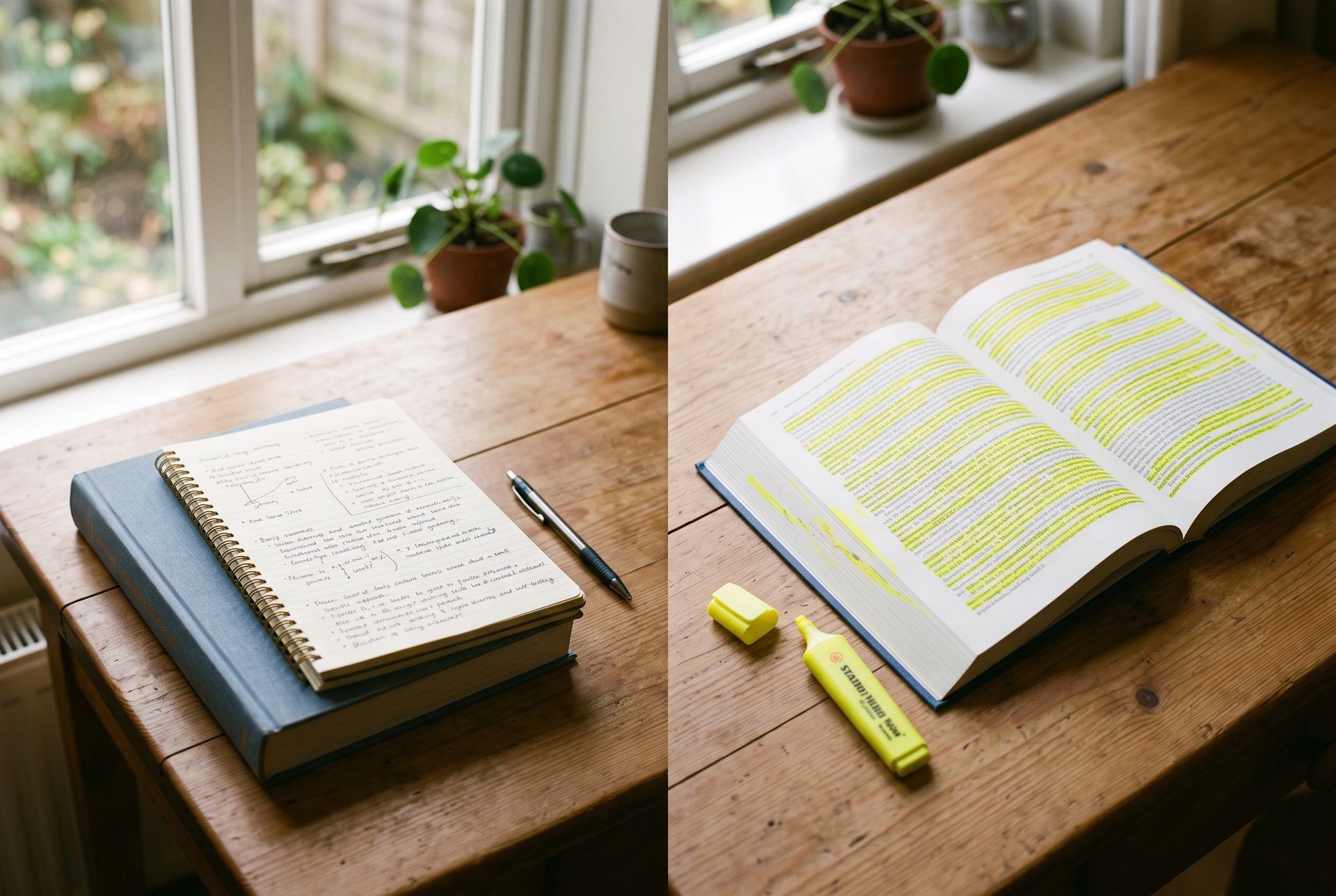
The best study method is practice testing, with spaced practice a close second. The two worst are highlighting and rereading. That ranking is not an opinion. It comes from a review published in Psychological Science in the Public Interest, where five researchers led by John Dunlosky read decades of studies on ten common study methods and scored each one as high, moderate, or low utility. Only two methods earned a high score. Five earned a low score. And the low-scoring group happens to include the methods most students use every single day.
This guide gives you the full ranking, from best to worst. For each method you get a plain answer on what it is, what the research found, and exactly how to use it (or what to use instead). No theory you cannot act on.
Let's start with the whole list in one place.
What is the best study method? All 10 ranked
Here is every method, ranked. The "evidence" column shows the rating from the Dunlosky review. The "effort" column is our own note on how hard the method is to start using.
| Rank | Method | Evidence | Effort to start | Use it? |
|---|---|---|---|---|
| 1 | Practice testing | High | Low | Yes, every session |
| 2 | Spaced practice | High | Low | Yes, plan it once |
| 3 | Interleaving | Moderate | Medium | Yes, for problem subjects |
| 4 | Elaborative interrogation | Moderate | Low | Yes, for fact-heavy topics |
| 5 | Self-explanation | Moderate | Medium | Yes, for hard concepts |
| 6 | Summarization | Low | Medium | Only if you are trained |
| 7 | Imagery for text | Low | Medium | Rarely |
| 8 | Keyword mnemonic | Low | High | Rarely, and only for vocabulary |
| 9 | Highlighting | Low | Very low | As a marker only, not as study |
| 10 | Rereading | Low | Very low | No, replace it |
Two things stand out.
First, the best methods are not the hardest ones. Practice testing and spaced practice both sit in the "low effort to start" column. You do not need an app, a course, or a system. You need to close your book and try to remember, and you need to do that on more than one day.
Second, the worst methods are the easiest. Rereading and highlighting cost almost nothing in effort. That is exactly why students pick them, and exactly why they fail.
Why most students pick the wrong method
Students choose bad study methods because bad methods feel good. When you reread a page, it gets easier to read each time. Your brain reads that smoothness as "I know this." Psychologists call this the fluency illusion. The feeling of knowing goes up while the actual knowing stays flat.
The survey data on this is stark. Jeffrey Karpicke, Andrew Butler, and Henry Roediger asked 177 college students to list the study strategies they used and rank them. Rereading notes or the textbook was named by 84% of students, and 55% listed it as their number one strategy. Only 11% mentioned testing themselves at all, and just 1% called it their top method.
So the single most popular study method in that sample was also one of the five lowest-rated in the research. That gap is the whole problem this article is trying to fix.
Dunlosky himself pointed at the simplest fix available. Speaking about the review's findings, he said students would benefit "by just replacing rereading with delayed retrieval practice." One swap. Nothing else changes.
A later survey by Marissa Hartwig and John Dunlosky, published in Psychonomic Bulletin & Review, asked 324 undergraduates about their habits and their GPA. Students who tested themselves and who planned their study time tended to have higher grades. Habits, not talent, were doing the work.
Now let's go through the ranking properly.
Tier 1: The two methods that clearly work
These two earned the only high ratings in the review. They work across ages, across subjects, and in real classrooms rather than just labs. If you change nothing else, change these.
1. Practice testing (also called active recall or retrieval practice)
Practice testing means closing your notes and trying to pull the answer out of your head before you check it. That is the entire method. Flashcards count. Past papers count. Covering a page and writing down what you remember counts. Looking at the answer while you "test" yourself does not count.
What the research found. The most quoted study here is by Henry Roediger and Jeffrey Karpicke at Washington University in St. Louis, published in Psychological Science in 2006. Students read short science passages. One group read the passage four times. The other group read it once, then spent the remaining time writing down everything they could remember, with the text hidden.
Five minutes later, the rereading group looked like winners. They recalled 83% against 71% for the testing group. They also felt more confident.
One week later, the result flipped hard. The rereading group could produce 40% of the passage. The testing group produced 61%. The students who studied the most remembered the least.
That is a 21 point gap from the same amount of time, with no extra material and no feedback given.
Why it works. Every time you successfully pull a fact out of memory, you make that memory easier to reach next time. Rereading puts information in front of your eyes. Retrieval builds the road you will actually need on exam day, because an exam is a retrieval task, not a reading task.
How to use it today.
- Read a section once, properly, with your full attention.
- Close the book.
- Write down everything you remember on a blank page. Do not peek.
- Open the book and check what you missed.
- Study only what you missed, then repeat step 3 later.
That fifth step matters. Most students reread everything again. You only need the gaps.
Ways to build it into your week. Turn your notes into questions and run them through a free flashcard generator so you have a deck ready before exam week starts. If you want the full method with more examples for different subjects, our guide on what active recall is and how to use it goes deeper. A close cousin worth knowing is the blurting method, which is free recall onto a blank page, done fast.
The honest catch. Practice testing feels worse than rereading. You will stare at a blank page and feel like you know nothing. That feeling is the method working, not failing. Researchers call this a desirable difficulty. If studying feels effortless, very little is being built.
2. Spaced practice (also called distributed practice)
Spaced practice means splitting your study time across several days instead of doing it all at once. Four sessions of one hour on four days beats one four-hour session, even though the total time is identical.
What the research found. Nicholas Cepeda, Harold Pashler, Edward Vul, John Wixted, and Doug Rohrer ran a large review, published in Psychological Bulletin in 2006. They pulled together 839 separate assessments of spacing across 317 experiments in 184 articles. Spread-out study beat crammed study again and again.
They also found something more useful than "spacing is good." The best gap between reviews depends on how long you need to hold the material. The longer you need to remember it, the longer the gap should be.
That lab finding held up in real classrooms. A 2025 meta-analysis by Rhys Mawson and Sean Kang, published in Behavioral Sciences, screened over 3,000 articles and analysed 31 classroom effect sizes covering more than 3,000 students. Spaced practice beat massed practice with a moderate effect size (d = 0.54). The gains were biggest when the test was further away, which is exactly the situation you are in during a normal semester.
Why it works. Forgetting a little is useful. When a memory has faded slightly and you pull it back, the act of pulling it back strengthens it more than reviewing something you still remember perfectly. Cramming never lets anything fade, so nothing gets that strengthening.
How to space your reviews. Use gaps that grow. A simple schedule that works for most students:
| Review | When | Roughly how long |
|---|---|---|
| 1st | Same day you learned it | 10 minutes |
| 2nd | Next day | 10 minutes |
| 3rd | 3 days later | 15 minutes |
| 4th | 1 week later | 15 minutes |
| 5th | 2 to 3 weeks later | 15 minutes |
That is around 65 minutes total per topic, spread over a month. Compare that to a four-hour cram the night before, which costs more time and delivers less.
Ways to build it into your week. The hard part of spacing is not the idea, it is remembering to do it. Set the schedule once in a free study planner and let the plan remember for you. If you have a date locked in, an exam countdown timer makes the gaps concrete instead of vague. And if finals are close, our guide on preparing for finals without cramming shows how to build the schedule backwards from the exam date.
The honest catch. Spacing only helps if you actually start early. If your exam is tomorrow, spacing is no longer available to you, and cramming is genuinely your best remaining option. Spacing is a decision you make in week one, not week fourteen.
Tier 2: The three methods worth adding
These earned moderate ratings. The evidence is good but thinner, often because the research is newer or has been tested in fewer real classrooms. Use them, but treat Tier 1 as the base.
3. Interleaving
Interleaving means mixing different problem types in one session instead of doing all of one type, then all of the next. Instead of 20 quadratic equations followed by 20 geometry problems, you shuffle them so no two problems in a row use the same method.
What the research found. Doug Rohrer and Kelli Taylor taught college students to find the volume of four unusual solids. One group practised in blocks, all of one shape and then all of the next. The other group got the same problems shuffled.
During practice, the blocked group looked far better. Of course they did. They knew which formula to use before they read the question.
On a test one week later, the interleaved group scored 63%. The blocked group scored 20%.
Rohrer and colleagues later took this into real classrooms. In a study published in Psychonomic Bulletin & Review in 2014, 140 grade 7 students received either blocked or interleaved practice over nine weeks, followed by a surprise test two weeks later. Interleaved practice scored 72% against 38% for blocked practice.
Why it works. In a blocked assignment, you never have to decide which method to use, because the heading already told you. In a real exam, nobody tells you. Interleaving trains the skill an exam actually tests: reading a problem and choosing the right approach.
How to use it.
- Learn one method properly in a block first. Interleaving is for practice, not for first contact.
- Once you know three or four methods, build a mixed set where no two consecutive problems match.
- Shuffle your flashcard deck instead of running it in chapter order.
- Mix old chapters into this week's practice, not just the current one.
The honest catch. Interleaving will make your practice scores drop. Rohrer and Taylor found the blocked group performed better during the session in almost every comparison. You have to accept looking worse now to be better on test day. That trade is hard to sit with, which is why almost nobody does it.
4. Elaborative interrogation
Elaborative interrogation means asking "why is this true?" for every fact you study, and answering it out loud. It turns a flat fact into a connected one.
Instead of memorising "metals conduct electricity," you ask: why do metals conduct electricity? Because they have free electrons that move through the structure. Now the fact has a reason attached, and reasons are far easier to remember than isolated statements.
How to use it. After each fact in your notes, write a one-line "because...". If you cannot finish the sentence, you have found something you do not actually understand yet. That is useful information, and it is exactly what practice testing would have caught anyway.
This works best in subjects built on facts that have explanations behind them, like biology, chemistry, economics, and history. It works less well for pure arbitrary lists, like vocabulary in a new language, where there is often no "why" to find.
Why it is only moderate. The Dunlosky review noted that methods in this tier have not been tested enough in real classrooms to earn a high rating. The lab results are good. The classroom results are still thin.
5. Self-explanation
Self-explanation means talking yourself through how you solved something, step by step, in your own words. It sits close to elaborative interrogation, but it is aimed at processes rather than facts.
After you solve a maths problem, do not move straight to the next one. Say out loud: "I used the quadratic formula here because the equation would not factorise. Then I substituted a, b, and c. Then I simplified the square root."
How to use it. Explain the solution as if teaching someone who has never seen it. When you hit a step you can only describe as "then you just do this bit," you have found the gap. This is the same principle behind the Feynman technique, which is really self-explanation with a stricter rule about using simple words.
When it helps most. Problem-based subjects: maths, physics, engineering, statistics, programming. Anywhere the exam asks you to produce a method rather than recall a fact.
Why it is only moderate. It takes real time. Explaining every step slows a study session down noticeably, and the research has not yet shown that the payoff justifies that cost in every setting.
Tier 3: The five methods that mostly do not work
These five received low ratings. That does not mean they are useless in every situation. It means the conditions where they help are narrow, and most students are not in those conditions. Here is what to do instead of each one.
6. Summarization
Writing summaries helps some students, but only the ones who have been trained to write good ones. That is the finding, and the training part is the catch. Most students write summaries that copy the original wording and keep the original order, which involves very little thinking.
A summary written by copying is closer to transcription than to study. A summary written from memory, with the book closed, is practice testing wearing a different hat, and that version works well.
Do this instead. Close the book and write the summary from memory. Then open the book and check it. You have now converted a low-utility method into a high-utility one with a single change.
7. Imagery for text learning
Making mental pictures while reading helps a little, in narrow conditions, mostly with concrete material. If the text describes a physical scene, imagery can help. If the text is abstract, there is often nothing to picture.
The review rated it low because the benefits appear under limited conditions and do not travel well across subjects or test types.
Do this instead. For anything spatial or structural, draw it. A rough diagram of a process, a cycle, or a system beats an imagined one, because drawing forces you to commit to a structure and shows you what you cannot place.
8. The keyword mnemonic
The keyword mnemonic links a foreign word to a sound-alike word in your language plus a mental image. To learn that "pato" means duck in Spanish, you might picture a duck patting something.
It works, but narrowly. The review found it helps mainly with limited material and over short retention windows, and it takes a lot of setup time per item. Building a good keyword for 200 vocabulary words is slower than just testing yourself on them 200 times.
Do this instead. Use spaced flashcards for vocabulary. Save mnemonics for the handful of items that refuse to stick after several rounds. That is the right job for them: a rescue tool, not a system.
This is different from the memory palace technique, which handles ordered lists and long sequences well and has its own body of evidence.
9. Highlighting and underlining
Highlighting is one of the most used study methods and one of the least effective. The review rated it low utility. In many studies, highlighting performed no better than plain reading.
The problem is that highlighting feels like work while requiring almost none. You can highlight an entire page while thinking about dinner. Worse, many students highlight too much, which removes the only benefit highlighting could have had, which is making the important parts stand out.
There is also a subtler cost. Highlighting can pull your attention to individual sentences and away from how ideas connect, which is usually what the exam is really testing.
Do this instead. Highlight sparingly, and treat the marks as a to-do list rather than as studying. Rule of thumb: if more than one sentence in ten is coloured, you are marking, not selecting. Then do the real work, which is closing the book and retrieving what those marks pointed at.
10. Rereading
Rereading is the most popular study method and the weakest one on this list. We covered the numbers earlier: 84% of students in the Karpicke survey used it, 55% ranked it first, and in the Roediger and Karpicke experiment it lost by 21 points after a week.
Rereading is not completely worthless. The first read is necessary, obviously. A second read spaced out by a few days is meaningfully better than a second read five minutes later. But past that, returns fall away fast, and every extra reread is time that could have gone to retrieval.
Do this instead. Read once. Then test. Then reread only the parts you failed to retrieve. This single change converts your weakest method into your strongest one, and it costs no extra time.
Which method should you use for your subject?
The top two methods work everywhere, but the moderate ones are subject-specific. Practice testing and spacing apply to every subject you will ever take. The rest depend on what your exam actually asks you to do.
Here is a quick match-up.
| Subject type | Best mix | Skip |
|---|---|---|
| Biology, chemistry, medicine | Practice testing + elaborative interrogation | Highlighting textbooks |
| Maths, physics, engineering | Interleaving + self-explanation | Rereading worked examples |
| History, law, politics | Practice testing + elaborative interrogation | Copying summaries |
| Languages and vocabulary | Spaced flashcards | Building mnemonics for every word |
| Programming and statistics | Self-explanation + interleaving | Rewatching tutorials |
| Essay subjects and literature | Retrieval of arguments, not quotes | Highlighting whole paragraphs |
A few notes on why these pair the way they do.
Fact-heavy science subjects reward "why is this true?" because almost every fact has a mechanism behind it. Knowing the mechanism means you can rebuild a forgotten fact instead of losing it.
Problem-solving subjects reward interleaving more than anything else, because the exam question will not tell you which method to use. This is the single highest-leverage change a maths or physics student can make.
Language learning is the one place where flat, spaced repetition of flashcards genuinely is the main event. There is often no reasoning to attach, so volume plus spacing wins.
Essay subjects are where students most often waste time. Highlighting a paragraph of literary criticism feels productive and teaches nothing. Retrieving the argument structure from a blank page teaches a lot. If your exam asks you to build an argument, practise building arguments, not recognising them.
What about the methods that are not on this list?
The Dunlosky review covered ten specific techniques. Plenty of popular study advice was not in scope, which does not automatically make it bad. Here is where the common ones sit.
The Pomodoro technique is not a learning method, it is a time management method. It controls when you work and when you rest, not how you encode information. It pairs well with everything in Tier 1, because retrieval practice is tiring and structured breaks make it sustainable. Use a free Pomodoro timer to run sessions, then fill those sessions with practice testing rather than rereading.
Note-taking methods like Cornell, mind mapping, and outlining shape how you capture information in class. They are useful, but capture is not learning. The Cornell method is popular partly because its cue column builds retrieval questions into the page by design. If you want a comparison, see our guide to the best note-taking methods.
The memory palace was not one of the ten, though the keyword mnemonic was. Memory palaces have solid evidence for ordered material, which is a different job from understanding a concept.
Memory techniques for large volumes of material sit alongside this ranking rather than inside it. If your problem is sheer quantity rather than method choice, our guide on how to memorize faster covers the techniques built for that job. For a broader set of practical habits beyond these ten methods, see our study tips that actually work.
Study music, study aesthetics, and colour-coded notes have no serious evidence base for improving retention. They are not harmful. They are just not the thing doing the work, and they can quietly eat the hours the real methods needed.
Cramming works for tomorrow and fails for next month. If your exam is in fourteen hours, cram without guilt. Just know you are buying a short-term result. Our 7-day exam plan covers what to do when the calendar is already tight.
How to combine the top three methods in one session
The strongest study session uses retrieval, spacing, and interleaving together. They are not competing options, they stack. Here is a 50-minute session that uses all three.
Minutes 0 to 5: Blank page recall. Before you open anything, write down everything you remember from last session. This is retrieval and it is spaced, because time has passed since you learned it. Do not check your notes yet.
Minutes 5 to 10: Check and mark gaps. Open your notes. Mark only what you missed. This is the entire purpose of the highlighter.
Minutes 10 to 30: Mixed practice. Work through problems or questions that mix today's topic with two older topics. Never two of the same type in a row. This is interleaving.
Minutes 30 to 35: Break. Stand up. Leave the desk. No screen.
Minutes 35 to 50: New material, then immediate recall. Read the new section once. Close it. Write what you remember. Check.
Notice what is missing from those 50 minutes: no rereading, no highlighting as a study activity, no summarising with the book open. Every block is either input or retrieval, and retrieval gets more of the clock than input does.
How to test yourself when you have no questions
The most common reason students skip practice testing is that nobody gave them questions. No past papers, no textbook question bank, no quiz at the end of the chapter. So they fall back on rereading, because rereading needs nothing.
You do not need someone else's questions. Here are five ways to generate your own, ordered from fastest to most thorough.
1. The blank page (30 seconds to set up). Close everything. Write the topic name at the top of a page. Write down everything you remember. This needs no preparation at all and it is the single fastest form of retrieval available to you.
2. Turn your headings into questions (2 minutes). Look at your notes and read only the headings. Turn each one into a question. A heading that says "Causes of inflation" becomes "What are the causes of inflation?" You now have a question set built from material you already wrote.
3. The cover-and-recall (instant). Put a blank sheet over your notes. Slide it down one line at a time. Before each line appears, say what it will be. This works well for sequences, processes, and formulas.
4. Flashcards for anything with a clean two-sided answer (10 minutes). Terms, dates, formulas, definitions, vocabulary. Anything where one prompt has one answer. Build the deck once and it serves you all semester. A flashcard generator speeds this up when you have a long list of terms.
5. Teach it to an empty room (5 minutes). Explain the topic out loud as if someone is listening. Every time you stall, you found a gap. This is self-explanation and practice testing at the same time, and it needs no materials.
The rule underneath all five: if you can see the answer, it is not a test. That is the only thing you have to get right.
A one-week schedule you can copy
Here is what the whole ranking looks like applied to a single week for one subject. Adjust the days to your own timetable.
| Day | What you do | Method used |
|---|---|---|
| Monday | Learn new topic, then blank page recall | Practice testing |
| Tuesday | 10 minute recall of Monday, plus new topic | Testing + spacing |
| Wednesday | Mixed problem set from Monday and Tuesday | Interleaving |
| Thursday | New topic, plus "why is this true?" for each fact | Elaborative interrogation |
| Friday | Full-week recall from blank page, no notes | Testing + spacing |
| Saturday | Mixed problem set across all four topics | Interleaving |
| Sunday | Rest, or 15 minute review of Friday's gaps only | Spacing |
That is under four hours across the week for one subject, and it uses every high and moderate rated method on the list. Compare it to four hours of rereading the night before, which uses only the worst one.
Set this once in the study planner and you will not have to think about the schedule again.
Five mistakes that undo good methods
1. Testing yourself with the answer visible. If your eyes can reach the answer, your brain will not bother retrieving it. Cover it completely. This is the single most common way students think they are doing active recall when they are not.
2. Spacing without ever closing the loop. Reviewing on five different days is only useful if you are retrieving on those days. Five spaced rereads is still five rereads.
3. Interleaving before you have learned anything. Mixing problem types when you do not yet know any of the methods produces confusion, not learning. Block first to learn the method, then interleave to keep it.
4. Judging a method by how it feels. Every effective method on this list feels harder than the ineffective ones. If you switch back to rereading because retrieval "wasn't working," you switched back because it felt bad, not because it failed. The Roediger and Karpicke study is the clearest warning here: the group that felt most confident performed worst.
5. Studying the material you already know. It is comfortable to review the chapter you understand. It changes nothing. Your gaps are the only place your score can move. This is also why the check step matters more than the recall step.
What to expect in the first three weeks
Switching methods feels worse before it feels better, and most students quit during the "worse" part. Knowing the shape of it in advance makes it much easier to push through.
Week one: it feels bad. You will close your book, stare at a blank page, and produce very little. This is not a sign the method is failing. You are seeing, accurately and for the first time, how much you actually knew. Rereading was hiding that number from you. Expect to feel less prepared than usual, even though you are more prepared than usual.
Week two: the gaps get smaller. Your blank page starts filling up. The second recall of a topic is noticeably easier than the first, and the third is easier again. This is also where spacing starts to pay, because you are now retrieving things you learned a week ago rather than an hour ago.
Week three: it starts to feel normal. Sessions get shorter, because you stop restudying material you already retrieved successfully. Most students find they are spending less total time than before, which is the part nobody expects.
When you will see it in your grades. Realistically, the first assessment that falls at least two weeks after you switch. Anything sooner was already mostly decided by how you studied before. Give it a full topic cycle before you judge it.
One warning worth repeating: your confidence will lag behind your ability for a while. In the Roediger and Karpicke experiment, the group with the worst results was the group that felt best prepared. Do not use your feelings as the measure. Use the blank page.
How this ranking was put together
This ranking is not our opinion about study advice. It is a summary of published research, with our own notes added on effort and practicality.
The evidence tiers come directly from the 2013 review in Psychological Science in the Public Interest by John Dunlosky, Katherine Rawson, Elizabeth Marsh, Mitchell Nathan, and Daniel Willingham, who assessed ten techniques and rated each as high, moderate, or low utility. We did not change any of their ratings.
The order within each tier is ours. Where the review gave two methods the same rating, we placed the one with larger and more replicated effects first, and we noted where classroom evidence exists rather than only lab evidence.
The "effort to start" column and the subject match-up table are our own additions. They are practical judgements, not research findings, and we have labelled them that way so you can weigh them accordingly.
Every number in this article traces to a named, linked study, and we have avoided quoting effect sizes without saying which study produced them. Where the evidence is thin, we said so, including for the three moderate-rated methods. Where a method has a real downside, such as interleaving making your practice scores drop, we said that too.
Written by Hamza, founder of StudyZoneHub, who builds free study tools and evidence-based guides for students.
The bottom line
If you remember one thing from this whole ranking, make it this: stop rereading and start retrieving. The single change from rereading to self-testing takes you from the bottom of the list to the top, costs no extra time, and is backed by the strongest evidence in the entire review.
Then add the second change: spread that retrieval across several days instead of one. Those two moves alone put you ahead of the large majority of students, who according to the survey data are still rereading and still ranking it first.
Everything else on this list is optimisation. Those two are the foundation.
Start with one topic this week. Read it once, close the book, write what you remember, and check. That is the whole method, and it is the one the research supports most strongly.
Sources
- Dunlosky, J., Rawson, K. A., Marsh, E. J., Nathan, M. J., & Willingham, D. T. (2013). Improving Students' Learning With Effective Learning Techniques. Psychological Science in the Public Interest, 14(1), 4-58. PubMed
- Roediger, H. L., & Karpicke, J. D. (2006). Test-Enhanced Learning: Taking Memory Tests Improves Long-Term Retention. Psychological Science, 17(3), 249-255. PubMed
- Karpicke, J. D., Butler, A. C., & Roediger, H. L. (2009). Metacognitive strategies in student learning. Memory, 17(4), 471-479. PDF
- Cepeda, N. J., Pashler, H., Vul, E., Wixted, J. T., & Rohrer, D. (2006). Distributed Practice in Verbal Recall Tasks. Psychological Bulletin, 132(3), 354-380. Full text
- Mawson, R. D., & Kang, S. H. K. (2025). The Distributed Practice Effect on Classroom Learning: A Meta-Analytic Review. Behavioral Sciences, 15(6), 771. Full text
- Rohrer, D., Dedrick, R. F., & Burgess, K. (2014). The benefit of interleaved mathematics practice is not limited to superficially similar kinds of problems. Psychonomic Bulletin & Review, 21(5), 1323-1330. PubMed
- Hartwig, M. K., & Dunlosky, J. (2012). Study strategies of college students. Psychonomic Bulletin & Review, 19(1), 126-134. PubMed
Frequently Asked Questions
What is the best study method according to research?
Practice testing, also called active recall or retrieval practice. In the 2013 Dunlosky review it was one of only two techniques out of ten to earn a high utility rating. In Roediger and Karpicke's 2006 experiment, students who tested themselves recalled 61% of a passage a week later, against 40% for students who reread it the same number of times.
What is the worst study method?
Rereading, closely followed by highlighting. Both received low utility ratings in the Dunlosky review, and both are among the most popular methods students use. Rereading is not useless for the first pass, but repeated rereading adds very little compared with testing yourself on the same material.
Why does rereading feel like it works when it doesn't?
Because of the fluency illusion. Each time you reread a page it becomes easier to read, and your brain treats that ease as a sign that you know the material. Familiarity is not the same as being able to produce the answer from memory, which is what an exam actually asks for.
Is highlighting completely useless?
Not completely, but it is not studying. Highlighting can work as a way of marking what to come back to. The problem is that most students treat the marking itself as the study session. Highlight sparingly, then close the book and try to recall what those marks pointed at.
How many study methods should I actually use?
Two are enough to start: practice testing and spaced practice. They are the only two that earned high utility ratings, they work in every subject, and neither needs any special setup. Add interleaving once those two are habits, especially if you study a problem-based subject.
Does interleaving really work if it makes practice harder?
Yes, and the harder practice is part of why. In Rohrer and Taylor's study, the blocked practice group performed better during practice but scored 20% on a test a week later, against 63% for the interleaved group. A 2014 classroom study with grade 7 students found 72% for interleaved practice against 38% for blocked.
How long should the gap be between spaced reviews?
It depends on how long you need to remember the material. Cepeda and colleagues found that the optimal gap grows as the retention interval grows. For a test in a few weeks, a schedule of same day, next day, three days, one week, then two to three weeks works well for most students.
Is cramming ever the right choice?
Yes, when the exam is tomorrow and spacing is no longer available to you. Cramming produces real short-term recall. It just fades fast, so it is a poor default and a reasonable emergency option. The decision that matters is made in week one of the semester, not the night before.
Do these study methods work for every subject?
Practice testing and spaced practice do. The moderate-rated methods are more subject-specific: elaborative interrogation suits fact-heavy sciences and humanities, self-explanation and interleaving suit maths, physics, statistics and programming, and spaced flashcards suit vocabulary and language learning.
Keep reading
Study Skills
Why Do I Forget Everything I Study? 9 Hidden Reasons and How to Make It Stick
Forget what you study the next day? Learn 9 common reasons, plus active recall, spaced repetition, sleep, and a simple system to remember more.
Exam Prep
How Many Questions Can You Miss on the SAT for a 1400, 1500, or 1600?
How many questions can you miss on the SAT for a 1400, 1500, or 1600? Real ranges for Math and Reading & Writing, plus why the module you get changes the answer.
Grades & GPA
Percentage to CGPA and CGPA to Percentage: Formula, Table and Examples
Convert percentage to CGPA and CGPA to percentage with the right formula. UGC 9.5 rule, flat 10 scale, offsets, full conversion tables, examples and FAQs.