How Many Questions Can You Miss on the SAT for a 1400, 1500, or 1600?
How many questions can you miss on the SAT for a 1400, 1500, or 1600? Real ranges for Math and Reading & Writing, plus why the module you get changes the answer.
 Written by Hamza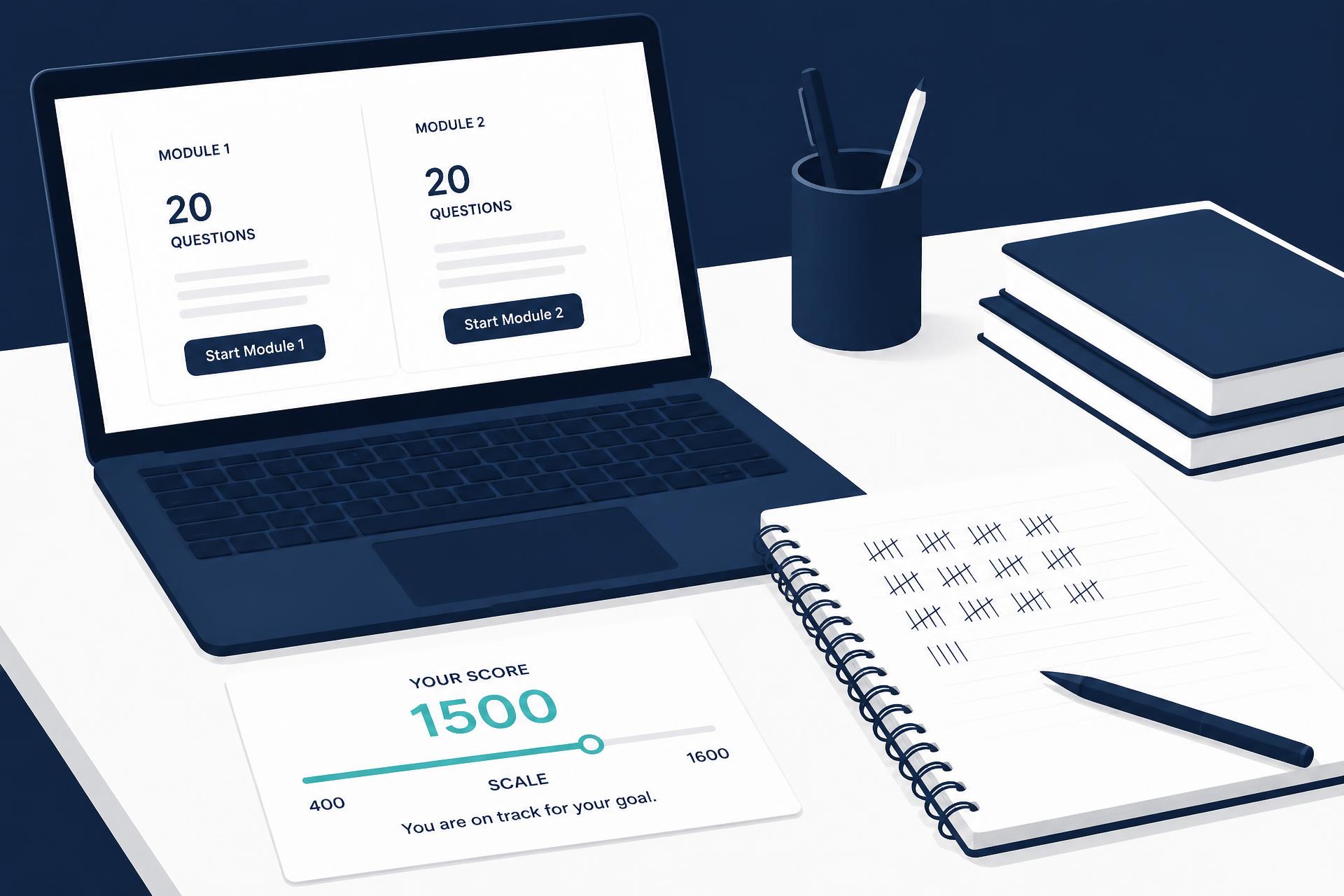
There is no fixed number, but there is a reliable range. To score 1600 you generally need every Math question correct and at most one Reading and Writing miss. For a 1500, most students can afford roughly 2 to 4 misses in Math and 3 to 5 in Reading and Writing. For a 1400, that widens to about 5 to 8 per section. The catch is that these numbers only hold if you are routed to the harder second module. If you land on the easier Module 2, your section score is capped somewhere around 600 to 650 no matter how few questions you miss, which puts a 1400 out of reach for that section before you have even finished it.
Below is what each target actually requires, why the estimates published across prep sites disagree with each other, and how to turn your own practice test misses into a realistic score.
How the digital SAT turns misses into a score
The digital SAT has 98 questions in total: 54 in Reading and Writing, split into two modules of 27, and 44 in Math, split into two modules of 22. Each section is scored from 200 to 800, and the two section scores add up to your total of 400 to 1600.
Three rules govern how misses translate into points:
- There is no penalty for a wrong answer. A blank and a wrong answer both score zero, so a guess is always better than leaving a question empty.
- Not every question counts. A small number of items in each module are unscored pretest questions used to build future tests. You cannot tell which ones they are.
- Questions are not worth the same. Scoring uses Item Response Theory, which weights each question by its measured difficulty. Two students who answer the same number correctly can finish with different section scores.
That last point is why no prep site can hand you an exact chart. What they can give you, and what the table below gives you, is a working range based on official Bluebook practice test scoring.
How many questions can you miss for a 1600, 1500, or 1400?
These ranges assume you are routed to the harder Module 2 in both sections. Treat them as planning targets, not guarantees.
| Target total | Section scores needed | Math misses (of 44) | R&W misses (of 54) |
|---|---|---|---|
| 1600 | 800 and 800 | 0, occasionally 1 | 0 to 1 |
| 1500 | about 750 each | 2 to 4 | 3 to 5 |
| 1400 | about 700 each | 5 to 8 | 6 to 9 |
| 1300 | about 650 each | 5 to 8 | 8 to 12 |
Notice that the Math ranges for 1400 and 1300 overlap. That is not a mistake in the table, it is the honest state of the published estimates. Different prep sites, all working from official practice tests, arrive at different numbers because each test form carries its own curve. Anyone showing you a single exact figure is rounding away real uncertainty.
One consistent pattern does hold: because Math has 44 questions and Reading and Writing has 54, each Math miss costs slightly more scaled points than each Reading and Writing miss. If you are choosing where to spend your last week of prep, Math accuracy usually buys more points per hour.
Free tool: SAT Score Calculator
Enter your correct answers from each module and see your estimated section scores and total on the 400 to 1600 scale, instead of guessing from a miss count. Calculate my score
Why the module you get changes the answer
Every student starts each section with the same Module 1. When you finish it, the testing app looks at how you performed and routes you into one of two versions of Module 2: a harder one or an easier one. Reading and Writing and Math route independently, so you can land on the hard path in one section and the easy path in the other.
The College Board does not publish the cutoff. Prep industry estimates put it at roughly 15 of 22 correct in Math Module 1 and around 18 of 27 in Reading and Writing Module 1, with the caveat that it shifts between test forms.
This matters more than your miss count, because the easier Module 2 carries a score ceiling. Published estimates for that ceiling range from about 560 at the low end to about 670 at the high end, clustering around 600 to 650. Even a flawless run on the easier module cannot break through it.
The practical consequence is blunt. If you get the easier Module 2 in both sections, your total is capped somewhere near 1200 to 1300, so a 1400 is off the table before Module 2 even begins. It also means deliberately underperforming on Module 1 to "get the easy version" is a losing strategy, not a hack.
Does missing a hard question cost less than missing an easy one?
Yes. Because scoring weights each question by difficulty, missing a question that most test takers get right costs you more than missing one that most test takers get wrong. Careless errors on easy and medium questions are the most expensive mistakes on the test.
This flips the usual advice about where to focus. Students chasing a 1500 often spend their prep hours on the hardest problem types, when the faster gain is usually in eliminating the two or three avoidable slips that show up on every practice test. Keep an error log and sort it by question difficulty rather than by topic. If most of your misses sit in the easy and medium bands, you have a pacing or carelessness problem, not a content gap.
How to use these numbers in your own prep
- Count misses per module, not per section. Your Module 1 count tells you which path you were on, which is the single biggest input into your score.
- Convert, do not guess. Feed your module-by-module correct answers into a scoring tool rather than eyeballing a total from a miss count.
- Set a miss budget, not a score goal. "Six or fewer misses in Math" is a target you can actually check mid-practice. "1500" is not.
- Answer every question. With no wrong-answer penalty, a blank is a guaranteed zero and a guess on a four-choice question is roughly a one in four shot.
- Work backwards from your test date. Divide the weeks left by the number of full practice tests you plan to sit, and lock the schedule now.
For the official rules on scoring and score release, the College Board's SAT Suite site is the primary source. For study tooling, our roundup of free websites every student should know covers the practice and revision tools worth pairing with your score tracking.
Free tool: Exam Countdown Timer
Set your SAT date and see exactly how many days and weeks are left, so you can plan how many full practice tests still fit before test day. Start the countdown
Frequently asked questions
How many questions can you miss on the SAT and still get a 1600?
Effectively none in Math. On most forms an 800 in Math requires every question correct, though some administrations allow a single miss. Reading and Writing is usually a little more forgiving at zero to one miss. If you are targeting 1600, plan for perfection rather than counting on a lenient curve.
Is there an official chart of questions missed to SAT score?
No. The College Board does not publish a raw-to-scaled conversion chart for the digital SAT, and it states that two students answering the same number of questions correctly can receive different section scores depending on which questions they answered correctly.
How do I know if I got the easy or hard Module 2?
The test never tells you during the exam. The clearest signal comes afterwards: if your section score lands in the low 600s or below despite feeling like you answered most of Module 2 correctly, you were most likely on the easier path.
Does guessing hurt my SAT score?
No. The digital SAT has no wrong-answer penalty, so a wrong answer and a blank both score zero points. Answer every question, even if you have to guess in the final seconds.
How many questions can you miss for a 1200?
A 1200 means roughly 600 per section, which is reachable even on the easier Module 2 path. Most students at that level miss somewhere in the region of 10 to 14 Math questions and 14 to 18 Reading and Writing questions, with wide variation by test form.
Should I retake the SAT if I got the easy Module 2?
If your target is above the ceiling that path allows, a retake is usually worth it, since the constraint was structural rather than a reflection of your ceiling as a student. Focus your prep on Module 1 accuracy, because that is the section that decides which path you get.
Stop guessing your score from a miss count
Enter your module-by-module correct answers and get an estimated section and total score in seconds.
Free, no signup, works on mobile and desktop.
SAT is a registered trademark of the College Board, which is not affiliated with and does not endorse StudyZoneHub. Score estimates on this page are based on publicly available practice test scoring data and should be treated as planning guidance, not official results.
Frequently Asked Questions
How many questions can you miss on the SAT and still get a 1600?
Effectively none in Math. On most forms an 800 in Math requires every question correct, though some administrations allow a single miss. Reading and Writing is usually a little more forgiving at zero to one miss. If you are targeting 1600, plan for perfection rather than counting on a lenient curve.
Is there an official chart of questions missed to SAT score?
No. The College Board does not publish a raw-to-scaled conversion chart for the digital SAT, and it states that two students answering the same number of questions correctly can receive different section scores depending on which questions they answered correctly.
How do I know if I got the easy or hard Module 2?
The test never tells you during the exam. The clearest signal comes afterwards: if your section score lands in the low 600s or below despite feeling like you answered most of Module 2 correctly, you were most likely on the easier path.
Does guessing hurt my SAT score?
No. The digital SAT has no wrong-answer penalty, so a wrong answer and a blank both score zero points. Answer every question, even if you have to guess in the final seconds.
How many questions can you miss for a 1200?
A 1200 means roughly 600 per section, which is reachable even on the easier Module 2 path. Most students at that level miss somewhere in the region of 10 to 14 Math questions and 14 to 18 Reading and Writing questions, with wide variation by test form.
Should I retake the SAT if I got the easy Module 2?
If your target is above the ceiling that path allows, a retake is usually worth it, since the constraint was structural rather than a reflection of your ceiling as a student. Focus your prep on Module 1 accuracy, because that is the section that decides which path you get.
Keep reading
Study Skills
Why Do I Forget Everything I Study? 9 Hidden Reasons and How to Make It Stick
Forget what you study the next day? Learn 9 common reasons, plus active recall, spaced repetition, sleep, and a simple system to remember more.
Study Skills
What Is the Best Study Method? All 10 Ranked by Research
The best study method is practice testing. See all 10 study methods ranked by research evidence, which ones work, and which ones waste your time.
Grades & GPA
Percentage to CGPA and CGPA to Percentage: Formula, Table and Examples
Convert percentage to CGPA and CGPA to percentage with the right formula. UGC 9.5 rule, flat 10 scale, offsets, full conversion tables, examples and FAQs.